Finding Contentment When You Feel Left Behind | Encrypted_Muslimah Reflections
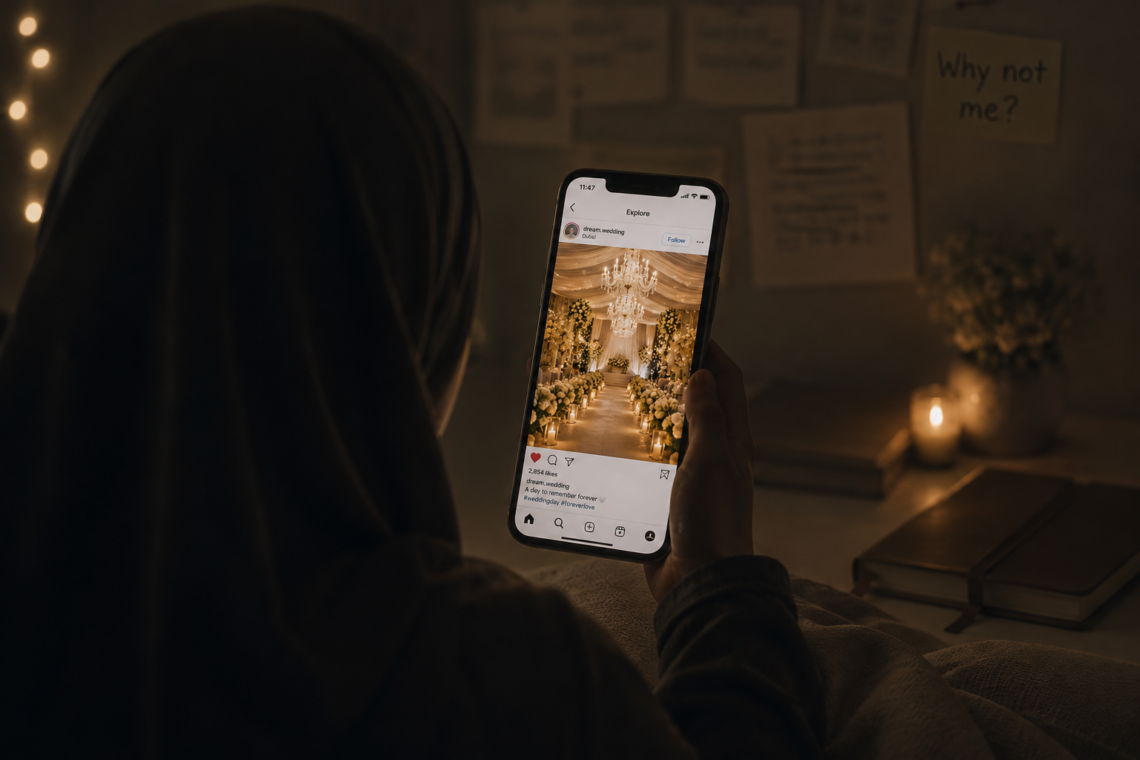
You scroll past a photo of someone’s new house, or their kids in matching outfits, or a trip you couldn’t imagine affording — and something in you deflates a little. It’s a small moment, gone in a few seconds. But it comes back more often than you’d like to admit.
But before that feeling grows into something bigger, understand this: what they have was never actually yours to want. Not because you don’t deserve nice things — because what you’re looking at isn’t what you think it is.
What the Hadith Teaches About Social Media Comparison
< How to Stop Comparing Your Life and Find Contentment p>‘Umar ibn al-Khattab felt that exact ache once — except it wasn’t about his own life. It was about the Prophet ﷺ’s.‘Umar walked into the Prophet ﷺ’s small room one day and found him lying on a bare straw mat. The room held almost nothing — just a small pile of tree pods. The mat had left marks on the Prophet ﷺ’s side from how thin it was. ‘Umar looked around, and he cried.
He said something like this: “O Messenger of Allah, Kisra and Caesar are living in total luxury, and you — the most beloved of Allah’s creation — are living like this?”
Are you in doubt, son of Al-Khattab? Those people simply had their good given to them early — in this life only. What’s coming for you is better, and it doesn’t run out.
That’s the whole idea behind a short line in Surah Ta-Ha.
Don’t look with longing at what We gave certain people to enjoy. It’s only the shine of this world, and it’s how they’re being tested. What your Lord has for you is better, and it lasts.
I think what makes this feel different than a general “don’t be jealous” reminder is how specific it is. This isn’t advice for people who have nothing. It’s advice the Prophet ﷺ himself needed to hear, in his own home, looking at his own bare walls. If comparison could reach him, it will reach any of us. That’s not a failure. It’s just what it feels like to be human, watching someone else’s life from the outside.
This isn’t a call to stop wanting a good life for yourself, or to assume everyone who has more than you is somehow losing out in the next one. Wanting ease and comfort is something the Prophet ﷺ prayed for himself. What’s actually being asked of you isn’t to stop wanting good things. It’s to stop measuring your life against someone else’s, since what you’re seeing was never really the full picture anyway.
The Prophet ﷺ pointed to the reason behind that pull in another teaching.
Devote yourself to My worship, and I’ll fill your heart with contentment and take care of your needs. Turn away from that, and I’ll fill your heart with distraction instead — and you still won’t get more than what was already written for you.
Read that twice, because it’s not saying worship gets you more stuff. It’s saying worship changes what’s happening inside your chest while you have whatever you have. The distraction and the discontent were never really about the house or the wardrobe. They were about where your attention had gone.
This next teaching explains why comparing yourself to others never actually fixes anything.
Whoever makes this world his main goal ends up scattered. His sense of lack stays sitting right in front of his eyes, no matter how much he chases. And in the end, he still only gets what was already meant for him. But whoever keeps the next life as his real aim finds everything coming together with ease. His heart settles. And this world ends up following him anyway, whether it wants to or not.
That last part is almost funny if you think about it. Chasing the world tends to leave you further from peace, not closer to it. Aiming somewhere else entirely is what tends to bring peace along anyway.
So if you notice yourself doing what ‘Umar did — that small deflating feeling, watching someone else’s life from the outside — you’re not doing anything wrong by noticing it. Notice it, and then remember what the Prophet ﷺ told him. Their good was just given early. What’s coming for you hasn’t even started yet.
- Qur’an, Surah Ta-Ha 20:131 — VERIFIED, translation confirmed accurate
- ‘Umar finding the Prophet ﷺ on a bare straw mat, his tears, and the Prophet ﷺ’s reply — VERIFIED, recorded in the Sahihayn (Bukhari and Muslim), cited by Ibn Kathir directly under this verse
- “O son of Adam, devote yourself to My worship…” — Jami at-Tirmidhi 2466 and Sunan Ibn Majah 4107, narrated from Abu Hurairah — VERIFIED as recorded; no weak-grading flag found
- “Whoever makes this world his main concern…” — Sunan Ibn Majah (Zuhd chapter), narrated by Zayd ibn Thabit — VERIFIED as recorded; no weak-grading flag found

Encrypted Muslimah
Just your sister behind the screen—reflecting, writing, and sharing from the heart. Welcome to Encrypted Muslimah.


You May Also Like

The 30-Second Sunnah Water Self Care Ritual That Can Transform Your Life as a Busy Muslim Mom

How to Give a Toddler Medicine Without Fighting: Tips & Sunnah Lessons